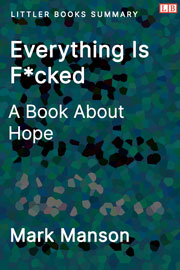
Book Description
“A Book About Hope”
If You Just Remember One Thing
There are three stages of emotional maturity. Childhood is driven by pleasures and avoiding pain. Adolescence is driven by rules, social rules, and doing th... More
Bullet Point Summary and Quotes
- Witold Pilecki is a Polish war hero who intentionally got himself arrested during World War II to sneak into the Auschwitz concentration camp. Inside, he built a secret resistance network, smuggled in supplies, and became the first person to warn the world about the Holocaust. After escaping and later spying on the Communist regime in Poland, he was captured, tortured, and sentenced to death. At his trial, he declared, "I have tried to live my life such that in the hour of my death I would feel joy rather than fear."
- Pilecki represents true heroism: creating hope where none seems to exist.
- Humans desperately need hope to avoid the Uncomfortable Truth: "One day, you and everyone you love will die. And beyond a small group of people for an extremely brief period of time, little of what you say or do will ever matter."
- Sadness and anger still mean you care about something. Instead, "the opposite of happiness is hopelessness, an endless gray horizon of resignation and indifference."
- Today, people are richer, healthier, and safer than at any other point in history, but depression, anxiety, loneliness, and suicide rates are climbing. Hope does not care about past progress, it only looks at future problems.
- The more we have, the more we fear losing it.
- Three pillars of hope: To feel hopeful, people need a sense of control over their lives, values worth working toward, and a community that shares those values.
- Elliot is a successful executive who had a brain tumor removed. Afterward, his IQ, memory, and logical reasoning remained completely normal, but he lost his job, his marriage, and his savings. Later it was found that the surgery had damaged Elliot's ability to feel emotions. Without feelings, Elliot could not judge whether one choice was better than another, proving that logic alone cannot guide our lives.
- This disproves the Classic Assumption -- the ancient belief that our rational mind should dominate our unruly emotions.
- Tom Waits joked, "I'd rather have a bottle in front of me than a frontal lobotomy."
- The mind works like a Consciousness Car containing two passengers:
- The Thinking Brain: Slow, logical, and careful, it acts as the navigator holding the maps.
- The Feeling Brain: Fast, emotional, and impulsive, it actually sits in the driver's seat because humans only take action when moved by emotion.
- When the Thinking Brain gives up and simply invents excuses to justify whatever the Feeling Brain craves, the car becomes a Clown Car, leading to narcissism, addiction, and delusion. Conversely, completely suppressing emotions makes life feel numb and meaningless.
- Because the Feeling Brain always drives, willpower alone fails. Instead of fighting your emotions, your Thinking Brain must listen to them with empathy, bargain with them, and align both brains around shared values.
- Laws of Emotion:
- First Law: For every action, there is an equal and opposite emotional reaction. Pain and pleasure create "moral gaps" -- a sense that something is unfair or owed. Emotions push us to equalize those gaps, and over time, our Feeling Brain ranks what feels good or bad into a personal value hierarchy.
- Second Law: Our self-worth equals the sum of our emotions over time. When we suffer pain that we cannot fix or retaliate against, our Feeling Brain assumes we must deserve it, creating shame and low self-worth. Receiving rewards we didn't earn creates inflated self-worth. Both extremes are forms of narcissism because both make us feel special and separate from the rest of the world.
- Third Law: Your identity will stay your identity until a new experience acts against it. Our Thinking Brain turns our feelings into sticky stories that become our identity. Because we defend our identity like our physical body, changing our values is always painful and requires new experiences or rewriting our personal narratives.
- Values create Emotional Gravity: people who share the same values pull together into tribes, while people with different values repel each other. Even though humans mostly want the same things, we obsess over our small differences, which drives tribes and nations into constant conflict.
- The author frames the third pillar, community, as a satirical guide on how to start your own religion. He argues that everyone belongs to a religion because everyone must take their highest value (their God Value) on faith. He divides religions into three types:
- Spiritual religions: Find hope in supernatural beliefs and an afterlife (like Christianity or Islam).
- Ideological religions: Find hope in worldly systems and "isms" (like capitalism, communism, nationalism, or environmentalism).
- Interpersonal religions: Find hope in other people, such as romantic partners, celebrities, politicians, or sports heroes.
- To build a religion, leaders target hopeless people, create an "us-versus-them" enemy to prevent criticism, invent shared rituals and sacrifices to relieve existential guilt, and promise a paradise they can't deliver.
- Because human pain is like a game of Whac-A-Mole (knock one problem down and another pops up) followers blame themselves when happiness doesn't arrive and rely on the leaders even more.
- Once any religion succeeds, it becomes corrupted because its main goal shifts from its original values to simply protecting itself: "Because the only thing that can ever truly destroy a dream is to have it come true."
- Philosopher Friedrich Nietzsche suffered terrible physical pain throughout his life and was cared for by early feminist pioneers like Meta von Salis.
- Nietzsche viewed human history as a clash between master morality (valuing strength, talent, and hierarchy) and slave morality (valuing equality, compassion, and protecting the weak).
- When the scientific revolution arrived, it created a new religion -- science -- where evidence became the God Value. Science brought material progress, making people rely less on spiritual promises of an afterlife and more on worldly ideologies.
- Nietzsche's famous warning that "God is dead" meant that because human ideologies are flawed and constantly challenged by reality, losing spiritual faith would trigger massive existential crises and violent ideological wars.
- Hope is not the cure for evil; it is part of the problem. Hope inspired heroes like Pilecki, but it also inspired Nazis and Stalinists. Hope requires believing that the present is broken and fighting against an enemy.
- "Everything being f*cked doesn't require hope; hope requires everything being fucked."
- Nietzsche championed amor fati (loving your fate): "My formula for greatness in a human being is amor fati: that one wants nothing to be different, not forward, not backward, not in all eternity." Instead of hoping for a better world, we must accept reality as it is and act better right now.
- Philosopher Immanuel Kant, who sought a moral rule based on reason rather than hope, inspired three stages of emotional maturity:
- Childhood: Driven purely by chasing pleasure and avoiding pain (like eating ice cream and avoiding hot stoves). Children see relationships as power struggles and throw tantrums when denied.
- Adolescence: Driven by rules, social roles, and bargaining. Adolescents do good things as a transaction (e.g., studying to get a job, or being nice to be liked) treating everything as a means to get something else.
- Adulthood: Driven by unconditional principles and virtues. Adults realize that the best things in life -- love, trust, honesty, respect -- are destroyed the moment you try to bargain for them. Adults do what is right simply because it is right.
- Kant says human consciousness (our ability to reason and create meaning) is the rarest and most valuable thing in the universe.
- From this, he created the Formula of Humanity: "Act that you use humanity, whether in your own person or in the person of any other, always at the same time as an end, never merely as a means."
- Treating people as ends means never manipulating, lying to, or using yourself or others just to reach a goal.
- “You must love someone without expecting anything in return; otherwise it's not truly love. You must respect someone without expecting anything in return; otherwise you don't truly respect him. You must speak honestly without expecting a pat on the back or a high-five or a gold star next to your name; otherwise you aren't truly being honest.”
- Modern society is suffering a maturity crisis. Democracy only works when citizens act like adults who compromise and respect rules. Today's rising political extremism on both the right and left is childish. Extremists refuse to compromise and demand an authoritarian figure to force the world to match their feelings.
- Why does a safer world make us feel more threatened? In the Blue Dot Effect experiment, when researchers showed participants fewer blue dots, fewer angry faces, or fewer unethical job proposals, people's minds automatically lowered their standards and began labeling purple dots as blue, neutral faces as angry, and harmless proposals as unethical. This shows that when real danger disappears, our brains invent new threats out of minor annoyances.
- Pain is the universal constant of human psychology. Studies show that whether people win the lottery or suffer a tragedy, their happiness almost always drifts back to a 7 out of 10. Chasing a permanent 10 traps us on a hedonic treadmill.
- Trying to eliminate all pain only lowers our pain tolerance and makes us emotionally fragile. We should aim to become antifragile, which means we grow stronger from stress rather than breaking.
- Pain creates stakes and gives life meaning.
- “The pursuit of happiness is a toxic value that has long defined our culture. It is self-defeating and misleading. Living well does not mean avoiding suffering; it means suffering for the right reasons. Because if we're going to be forced to suffer by simply existing, we might as well learn how to suffer well.”
- In the 1920s, philosopher Sigmund Freud's nephew, Edward Bernays, transformed advertising by realizing that people buy things based on emotions and insecurities rather than facts.
- He famously convinced women to smoke by staging a publicity stunt calling cigarettes "torches of freedom," tying tobacco to women's liberation.
- Economies create value in two ways:
- Innovations: Upgrade terrible pain into better pain (like modern medicine), making people stronger.
- Diversions: Help people numb and avoid pain (like junk food, entertainment, or social media), which can become addictive and make people fragile.
- Once a nation gets wealthy, businesses shift from risky innovations to easy, profitable diversions.
- The internet was originally meant to spread knowledge, but it turned into a massive diversion machine.
- Endless variety and comfort trap us in anxiety, loneliness, and compulsive habits (fake freedom).
- "The only true form of freedom, the only ethical form of freedom, is through self-limitation."
- "Extreme freedom can't be expected to lead to anything but a change to extreme slavery.” - Plato
- Indulging in fake freedom erodes the self-discipline and tolerance needed to keep democracy alive.
- Biological evolution is a contest to see which organism can process information best. Humans won because of our brains. But our emotional algorithms, built for small tribes, are poorly suited for a globally connected world with nuclear weapons and climate change.
- As AI grows smarter and begins improving itself, it will surpass human understanding. Humans will rely on these algorithms just as ancient people worshipped gods, making AI the Final Religion.
- Rather than fearing AI will wipe us out, superintelligent machines might surpass our flawed morality and help us evolve into something better.
- In the meantime, our job is to avoid destroying ourselves, which we can do by building technology and habits that encourage maturity, honesty, and resilience rather than exploiting our emotional weaknesses.
Everything Is F*cked: Resources
- Download this summary and 216+ other top nonfiction book summaries in one book (PDF, eBook, DOCX)
- Buy the book